Elixir and the BEAM for AI systems
What Together AI's $800M Round Says About Elixir
Together AI raised $800M at an $8.3B valuation. A since-removed job posting showed Elixir/Phoenix on the BEAM running its auth and access control.
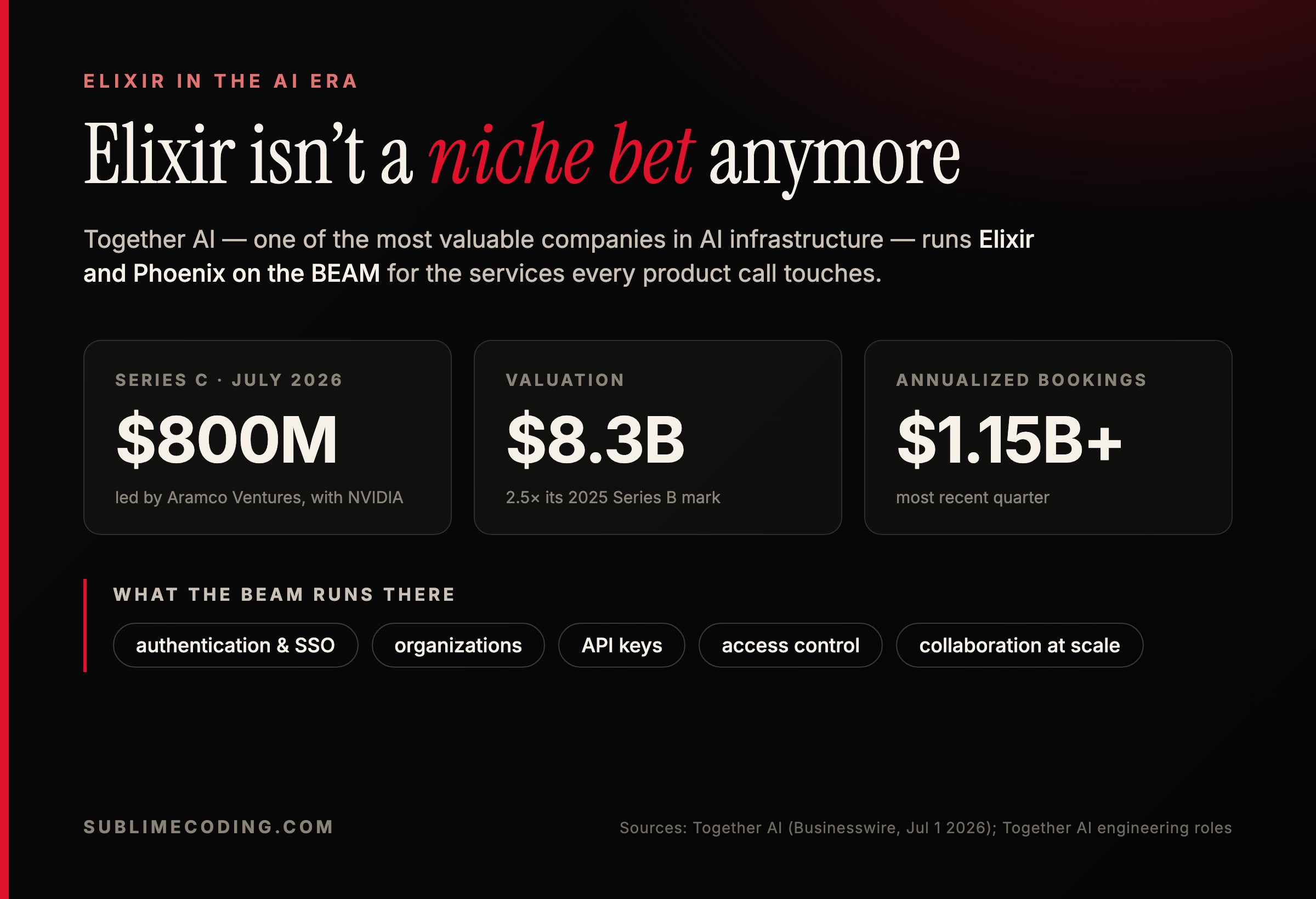
TL;DR: Together AI closed an $800M Series C at an $8.3B valuation on July 1, 2026, led by Aramco Ventures, with NVIDIA and General Catalyst participating, and annualized bookings past $1.15B last quarter. What doesn’t make the funding headlines: a Together AI engineering job posting, since removed, described Elixir/Phoenix services on the BEAM running authentication, SSO, OAuth, organizations, projects, API keys, and role-based access control, the layer every other product call in the company routes through. Elixir’s raw usage share is still low single digits. That Elixir most likely arrived with the December 2024 CodeSandbox acquisition (see the update below), so read it as where Elixir ended up inside a company at this valuation, not as a fresh bet.
Update, September 2, 2026: the Greenhouse job posting this post relied on has since been removed, and no archived copy exists. Together AI’s current job board lists no Elixir roles, and its public GitHub org shows none. The Elixir also appears to have arrived through the December 2024 acquisition of CodeSandbox, scoped to that team’s auth and org-management services, which this post did not disclose. On October 6, 2026 the body below was revised to match. The funding figures below still hold; the present-tense claim that Together AI is hiring Elixir engineers into its critical path does not. A row-by-row re-check of this and fourteen other “companies using Elixir” claims publishes here on September 24, 2026: Who Actually Runs Elixir in Production, Fact-Checked.
The round
On July 1, 2026, Together AI announced an $800 million Series C at an $8.3 billion post-money valuation, more than double the $3.3 billion mark from its Series B in early 2025. Aramco Ventures led the round; TechCrunch’s coverage lists Vista Equity Partners, General Catalyst, Emergence Capital, and NVIDIA among the participants, notes the prior $3.3 billion Series B mark, and reports annualized bookings past $1.15 billion in the company’s most recent quarter, on the back of enterprises moving inference workloads off closed frontier models and onto the open models Together AI serves at a fraction of the cost.
None of that is an Elixir story on its face. Together AI is a GPU-cloud-and-inference company; its headline product is compute, not a web framework. But funding announcements and cap tables don’t tell you what’s actually running in production, and the interesting part of this story is in the job board, not the press release.
The receipt: what’s actually on the BEAM
Together AI’s Greenhouse listing for a Software Engineer role on its Identity & Collaboration team, part of the Product Foundations engineering group, spelled out the stack in plain language: “Build and ship features across the stack — TypeScript/Next.js on the frontend and Elixir/Phoenix services on the backend.” The scope of that backend is “authentication flows (including SSO and OAuth), organizations, projects, API keys, and role-based access controls,” and engineers on the team were expected to “learn the Elixir/Erlang VM (BEAM) and how we run it in production.”
Read that list again. None of it is a marketing site, a docs portal, or an internal admin tool (the places a startup tends to park a language nobody wants to bet the company on). It’s identity and access control: the layer that authenticates every request, scopes every API key, and enforces every permission check across the product. If that layer goes down or gets the concurrency model wrong, nothing else in the platform works correctly either. That layer ran on Elixir and Phoenix, on the BEAM, at least while the posting was up.
I’ve made the architecture case for exactly this kind of choice before: why Elixir fits the AI startup backend covers the concurrency and supervision reasoning in full, and I won’t re-run it here. What’s worth sitting with instead is that a company at an $8.3 billion valuation kept that code on its critical path.
Why raw adoption share still says “niche”, and why that’s the wrong number to read
Here’s the concession, stated plainly instead of buried: by raw usage, Elixir is not mainstream. In the 2025 Stack Overflow Developer Survey, Elixir sits at 2.7% of all respondents, low single digits, well behind JavaScript, Python, and the other top-line languages. If you’re grading “has Elixir gone mainstream” as a flat yes/no against that number, the honest answer is no, and anyone telling you otherwise is selling something.
But raw adoption share answers the wrong question for this story. It tells you how many developers, in aggregate, across every kind of company and every kind of workload, happen to write Elixir day to day. It says nothing about where the growth is concentrating, or who is choosing it for the parts of their system that can’t afford to be wrong. Those are different questions, and the second one is the one funded AI infrastructure companies are answering with their hiring budgets right now.
A company at an $8.3B valuation putting Elixir on its identity and access-control critical path is a different kind of signal than a language-share percentage.
Adoption share is a lagging, backward-looking average across the entire industry, most of which isn’t building anything like what Together AI is building. It smooths a real signal into noise. The signal that actually matters for anyone deciding what to build a new AI-infrastructure backend in is “what are the best-capitalized, fastest-growing companies in the category choosing for the part of the system every request has to pass through,” not “what percentage of all developers use this.” Together AI running Elixir on that layer is a stronger data point for that narrower question than the aggregate percentage, with the caveat from the update above: it came with an acquisition, and the posting is gone.
It’s not an isolated one, either. Elixir’s flagship web framework, Phoenix, was the most admired web framework in Stack Overflow’s 2023 survey: more developers who had shipped on it wanted to keep using it than for React, Node.js, or Next.js, a satisfaction signal from the people who’ve actually run it, which is a very different thing from a popularity count of people who haven’t. Small usage share and high admiration from the people who use it in production is a specific pattern: a technology that loses people at the top of the funnel, before anyone’s actually run it, not engineers who try it. Together AI’s identity layer is what it looks like when that code reaches the critical path of a well-funded company.
One data point, but the right kind
I’d be doing you a disservice if I dressed this up as a “companies using Elixir” listicle, because a list of logos proves nothing on its own. What’s worth tracking instead is the pattern this round is one data point in: funded AI-infrastructure companies reaching for the BEAM specifically for the stateful, concurrent, always-on layer: identity, access control, collaboration, the connective tissue every other service depends on, while building the rest of their stack in whatever language fits the rest of their stack. It’s the same reasoning behind why the BEAM keeps turning up under AI agent workloads: the parts of a system that have to hold state, stay up, and coordinate concurrent work reliably are exactly the parts where the BEAM’s guarantees stop being a nice-to-have. That’s not “Elixir is eating the world.” It’s “Elixir is winning a specific, high-stakes layer of infrastructure at companies with the capital and the technical judgment to choose deliberately,” and that’s a narrower, more useful claim to make than the flat mainstream-adoption one, because it’s the claim the evidence actually supports. For Together AI specifically, the evidence is thinner than this post first said; the fact-checked roundup has the current state.
If you’re already building on Elixir and want the durable-execution side of this argument rather than the identity-layer side, I’ve covered that separately: running AI agent jobs on Oban instead of a bespoke queue is the same BEAM guarantees applied to a different critical path.
If you’re weighing the same choice for an AI startup’s backend (what belongs on the BEAM, what doesn’t, and where the concurrency model actually earns its keep instead of just sounding good in a pitch), that’s the conversation I have with founders and CTOs in fractional CTO and engineering leadership engagements. Bring the actual system you’re building; the right answer depends on what’s in it, not on a job posting from a company that isn’t yours.